A proactive, non-invasive approach to support cognitive function, delay memory decline, and manage the behavioral symptoms associated with early-stage dementia.
TMS aims to strengthen connectivity within the brain's memory and executive networks before significant atrophy occurs.
A critical window for intervention: stimulating the brain to reinforce fading memory pathways.
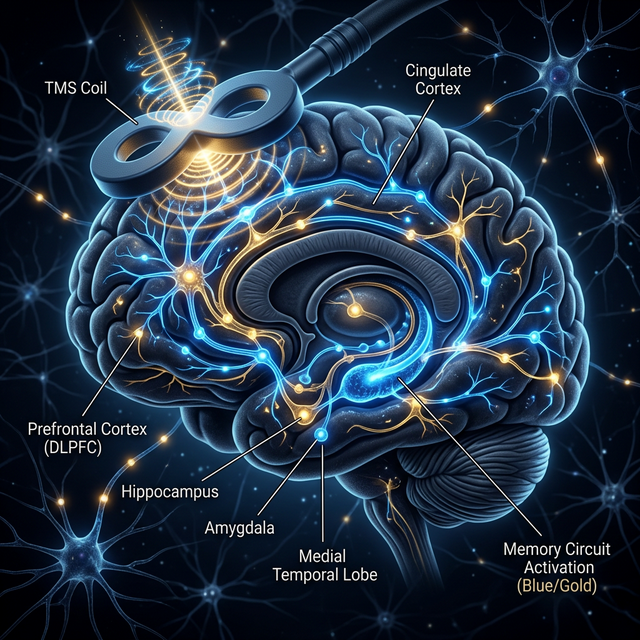
Mild Cognitive Impairment (MCI) is often the transitional stage between the expected cognitive decline of normal aging and the more serious decline of dementia. During this phase, intervention is crucial. Functional imaging shows that network connectivity in the brain begins to falter before significant physical shrinkage (atrophy) occurs.
TMS applies focused magnetic pulses to the **Dorsolateral Prefrontal Cortex (DLPFC)** and temporal regions, which are closely linked to the brain's memory centers, including the hippocampus. This stimulation promotes neuroplasticity—the brain's ability to form and reorganize synaptic connections, helping to compensate for early amyloid or tau pathology.
Research indicates that high-frequency TMS may enhance memory retrieval and executive function in MCI patients by temporarily boosting cortical excitability and increasing cerebral blood flow.
Improving the ability to hold and process information in the short term, such as recalling a phone number or following a conversation.
Enhancing planning, reasoning, and problem-solving skills by strengthening the prefrontal network.
Aiding language processing to reduce instances of "word-finding" difficulty, a common early sign of MCI.

Modulating the Default Mode Network (DMN) to preserve independence and cognitive reserve.
In early-stage Alzheimer's Disease (AD), pathological proteins disrupt communication between different brain regions, specifically impacting the Default Mode Network (DMN), which is crucial for memory consolidation and self-referential thought.
While TMS cannot cure AD or clear pathological plaques, it can act as "physical therapy for the brain." By delivering targeted electromagnetic pulses, TMS aims to maximize the efficiency of surviving neurons and stimulate collateral pathways. This cognitive neuromodulation may help to slow the rate of clinical decline and slightly prolong the period of independent living.
Multi-site stimulation protocols are often used to target both language (Broca's area) and executive (DLPFC) hubs.
TMS is often most effective when combined with active cognitive exercises, reinforcing the connections being stimulated.
Unlike treating depression, utilizing TMS for neurodegenerative conditions may require periodic "maintenance" sessions.
Providing relief for the emotional toll of cognitive decline without heavy sedation.
Cognitive decline is only one aspect of dementia. Up to 90% of patients will experience Behavioral and Psychological Symptoms of Dementia (BPSD), which include severe depression, agitation, anxiety, and apathy. These symptoms are often the primary cause of caregiver burnout and nursing home placement.
Traditional psychiatric medications (like antipsychotics) often carry significant risks for elderly dementia patients, including increased confusion and fall risk. TMS offers a powerful, localized alternative. Because TMS is FDA-cleared for Depression and Anxiety, we can adapt these protocols to target the mood-regulating circuits in dementia patients, calming agitation and lifting mood without systemic side effects.
| Symptom | TMS Impact |
|---|---|
| Dementia-Related Depression | Stimulates underactive prefrontal circuitry to restore mood balance, improving overall engagement. |
| Agitation & Anxiety | Can utilize inhibitory (low-frequency) TMS protocols over hyperactive regions to calm severe agitation. |
| Apathy | Boosts drive and motivation by activating reward pathways, helping patients participate more in daily life. |
We prioritize realistic goals, safety, and improving quality of life for the patient and their family.
Reviewing neuro-psych testing, MRIs, and medical history to ensure TMS is an appropriate and safe option for your specific stage.
We work closely with family members and caregivers to monitor progress, changes in behavior, and adjust protocols as needed.
Employing advanced TMS protocols to target different cortical hubs to address memory, executive function, and mood simultaneously.
Navigating cognitive decline is vastly challenging for both the patient and their family. Dr. Amin approaches Alzheimer's and MCI with a compassionate, realistic, and science-driven mindset. He utilizes TMS not as a cure, but as a stabilizing tool to enhance the brain's remaining reserves and improve daily mood and function.
Read Full BiographyHear from patients whose lives were transformed through Dr. Amin's care.
If you or a loved one are experiencing early signs of memory loss or dementia-related depression, schedule an evaluation to see if TMS may provide support.
Learn how targeted electromagnetic stimulation can support your brain health during times of cognitive change.
Book Your Consultation Today